Pheasant Hunting Colorado: Where to Go, What to Expect & Private Land Access


Mateo Lorenzo
07/30/2026
Infinite Outdoors was born on Colorado pheasant ground. Before we had elk properties, before we had fishing access, we were connecting hunters with private farms on the Eastern Plains where roosters would flush wild from standing corn and CRP grass. It is still one of my favorite hunts, and one of the most underrated experiences in Colorado.
Colorado pheasant hunting is best on private agricultural land where birds have not been pushed by other hunters all season. Infinite Outdoors has pheasant properties on the Eastern Plains -- working farms and ranches with CRP grass, grain fields, and the kind of cover that holds wild roosters. Browse pheasant properties at infiniteoutdoorsusa.com
Why Colorado for Pheasant?
Most people think of South Dakota or Kansas when they think of pheasant hunting. Colorado rarely makes the national conversation. But the Eastern Plains hold legitimate wild pheasant populations in the river valleys and irrigated farmland east of I-25, and the hunting can be excellent -- especially on private ground that is not hammered by walk-in traffic.
Colorado pheasant hunting also comes with a logistical advantage that other states cannot match. If you live along the Front Range, the best pheasant country is a 2-3 hour drive from Denver, Fort Collins, or Colorado Springs. You can leave home at 5 AM, hunt a full morning, and be back for a late dinner. No flights, no long road trips, no multi-day commitment required. For a day hunt with a dog and a couple of friends, it is hard to beat.
Hunt private land with Access+. Start your 7-day trial for day access to private properties across the US. Start your 7-day trial →
Where to Find Birds: A Regional Breakdown
Northeast Colorado -- The Core Range
The South Platte River valley from Sterling east to Julesburg is the heart of Colorado pheasant country. Washington, Yuma, Phillips, Sedgwick, and Logan counties consistently hold the highest bird densities in the state. The mix of irrigated corn, wheat stubble, CRP grass, and river-bottom cover creates ideal pheasant habitat. This is where CPW conducts its primary spring crow counts, and the 2025 data showed continued recovery from the 2020-23 drought.
The best hunting in this region is on private agricultural land where CRP fields border standing or harvested grain. Birds roost in thick grass, feed in grain fields at dawn and dusk, and use irrigation ditches and shelterbelts as travel corridors between the two. A hunter who understands those daily movement patterns can intercept birds predictably.
Key State Wildlife Areas: Prewitt Reservoir SWA in Washington County is one of the most productive public pheasant areas in the state. The cattail marshes and adjacent upland cover hold birds throughout the season. Expect pressure on opening weekend but solid hunting midweek.
Southeast Colorado -- Rebuilding but Worth Watching
The Arkansas River valley from Lamar to Holly and the surrounding counties (Prowers, Baca, Kiowa, Bent) make up Colorado's secondary pheasant range. Bird densities are historically lower than the northeast, and the region was hit harder by the 2020-23 drought. However, CPW's 2025 forecast indicates populations are trending upward in the southeast as well. The landscape here is drier and more open than the northeast, with less CRP and more dryland farming.
Key State Wildlife Areas: Queens SWA near Lamar offers hunting in irrigated bottomland habitat along the Arkansas River. Two Buttes SWA in Baca County provides walk-in access to grassland and wetland habitat. Both areas see less pressure than the northeast.
Front Range and Western Slope -- Not Pheasant Country
Pheasant habitat drops off sharply west of I-25. The foothills, mountains, and Western Slope do not support meaningful wild pheasant populations. There are a handful of private shooting preserves along the Front Range that release pen-raised birds, but that is a fundamentally different experience from hunting wild roosters on the plains. If you want wild pheasant in Colorado, you are going east.
The best pheasant habitat in Colorado is on private farmland -- CRP grass, standing corn, and shelterbelts that wild birds depend on. Infinite Outdoors partners with Eastern Plains landowners to open this ground to hunters. No walk-in crowds, no opening-weekend chaos, just quality upland cover with wild birds. Find pheasant properties at infiniteoutdoorsusa.com
Season Dates, Licenses & Bag Limits
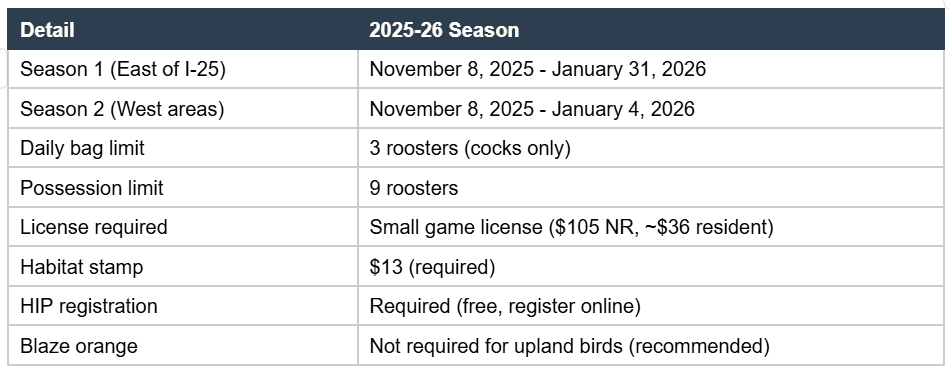
Source: CPW 2025-26 Small Game Brochure. Colorado pheasant licenses are over-the-counter and unlimited. No draw, no preference points, no caps. You can buy your small game license the morning of the hunt if you want.
The Population Situation: Drought Recovery
Colorado pheasant numbers cratered during the 2020-23 drought, compounded by a severe winter in 2022-23 that hit northeast Colorado hard. The 2024-25 harvest of approximately 26,000 birds represented a 62.5% increase over the previous year but remained the second-lowest harvest on record -- a sign of how deep the drought damage went.
The 2025-26 CPW forecast is cautiously optimistic. Three nesting seasons of reasonable weather have allowed populations to begin recovering, particularly in northeast Colorado. Spring crow counts showed improvement across most of the core range. The caveat is CRP acreage: total CRP enrollment across Colorado's pheasant range has declined significantly, meaning permanent nesting cover is shrinking even as bird numbers climb. Long-term pheasant population health depends on habitat as much as weather, and the habitat trend is not encouraging.
What this means for hunters: Expect a better season than 2024 but do not expect a return to pre-drought levels. The northeast will fish best. Private land with intact CRP grass and grain field edges will hold disproportionately more birds than public walk-in areas where cover has been degraded. Timing matters too -- CPW notes that the best hunting often comes later in the season after crops are harvested and birds concentrate in remaining cover.
The Private Land Difference for Colorado Pheasant
Here is the reality that most Colorado pheasant content does not address: the majority of productive pheasant habitat in the state is on private agricultural land. CRP fields, grain stubble, irrigation ditches, shelterbelts -- these features exist almost exclusively on working farms and ranches. State Wildlife Areas and Walk-In Access parcels provide public options, but they represent a small fraction of the total pheasant habitat, and they get disproportionate pressure relative to their size.
On opening weekend, a 640-acre Walk-In Access parcel in Yuma County might see 10-15 hunters. The pheasants in that field learn fast. By the second weekend of the season, the birds on public parcels are running instead of holding, flushing wild at 80 yards, and disappearing into private land where they are not disturbed. Meanwhile, a private farm two miles away that sees 1-2 hunting parties per season holds birds that behave like pheasants are supposed to -- holding in cover, flushing within shotgun range, and offering the kind of shooting that makes the drive worthwhile.
This is where Infinite Outdoors started. Before we had elk properties or fishing access across seven states, we were connecting Front Range hunters with Eastern Plains farmers who had great bird habitat and wanted to share it. Pheasant hunting on private ground is the hunt that built this company, and it remains one of the best experiences we offer.
What to Bring
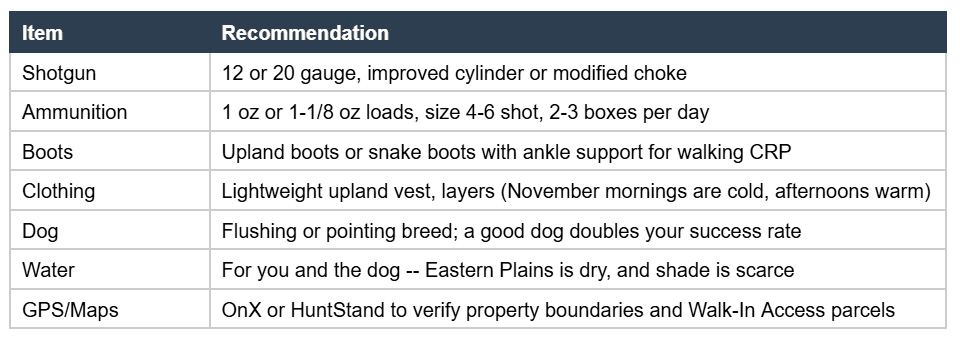
Making the Most of Your Season
The best Colorado pheasant hunting happens after opening weekend. Crops are harvested, birds concentrate in remaining cover, and pressure drops dramatically once the first-weekend crowds go home. A midweek hunt in late November or December on private ground with a good dog is one of the most enjoyable hunts Colorado offers. The pace is slower than chasing elk through timber, the shooting is sporty, and the landscape -- big sky, brown grass, distant mountains on the horizon -- is its own kind of beautiful.
And unlike elk or mule deer, you do not need to apply for a draw, build preference points, or plan a year in advance. You just need a small game license, a shotgun, and access to good ground.
Pheasant season is closer than you think. Infinite Outdoors has private farms and ranches on the Colorado Eastern Plains -- CRP grass, grain stubble, and wild roosters on ground that sees a fraction of the pressure of Walk-In Access parcels. Book your pheasant hunt at infiniteoutdoorsusa.com
Frequently Asked Questions
Q: Where is the best pheasant hunting in Colorado?
A: Northeast Colorado along the South Platte River valley, particularly in Washington, Yuma, Phillips, Sedgwick, and Logan counties. The mix of irrigated agriculture, CRP grass, and river-bottom cover supports the highest bird densities in the state.
Q: Do I need a special license for pheasant in Colorado?
A: No draw or special license is required. You need a Colorado small game license ($105 for non-residents, approximately $36 for residents), a habitat stamp ($13), and HIP registration (free). All are available over-the-counter with no caps.
Q: When does Colorado pheasant season open?
A: Pheasant season opens statewide on the second Saturday of November each year. For 2025-26, the opener is November 8, 2025. Season 1 (east of I-25) runs through January 31, 2026. Season 2 (western areas) runs through January 4, 2026.
Q: Are Colorado pheasant populations recovering from the drought?
A: Yes, but slowly. CPW's 2025-26 forecast shows populations ranging from slightly to significantly better than 2024 across the Eastern Plains. The 2024-25 harvest was approximately 26,000 birds, a 62.5% increase over the prior year but still the second-lowest on record. Recovery is ongoing.
Q: Do I need a dog to hunt pheasant in Colorado?
A: A dog is not legally required, but it dramatically improves your success rate and reduces lost birds. Pheasants are strong runners and hold tight in thick CRP grass. A good flushing or pointing dog turns a frustrating foot-push into a productive hunt. If you do not have a dog, hunt with a group of 3-4 people to cover more ground and push birds toward blockers.