Nymph Fishing for Trout: Rigs, Techniques & the Flies That Actually Work


Mateo Lorenzo
08/03/2026
I spent my first season of fly fishing convinced that if there was no rise, there was no fish. Once someone showed me how to dead-drift a Pheasant Tail under an indicator through a riffle, I realized I had been ignoring 90% of the trout in the river. Nymphing changed everything.
Looking for river access where you can actually work a nymph rig without dodging other anglers? Infinite Outdoors has private water across Colorado, Wyoming, and Montana -- stretches long enough to fish a full day without seeing another angler. Explore fishing properties at infiniteoutdoorsusa.com
Why Nymphing Catches More Trout Than Anything Else
The math is simple. Trout feed below the surface 80-90% of the time, eating mayfly nymphs, caddis larvae, stonefly nymphs, and midges as they drift along the bottom or tumble through the water column. Dry fly fishing is beautiful, but it only works during the 10-20% of the day when fish are actively feeding on the surface. Streamer fishing triggers reaction strikes from aggressive fish but misses the majority of trout that are quietly picking food off the bottom. Nymphing puts your fly where the food is, for the entire day, in nearly every water condition. It is not the most romantic way to fly fish, but it is the most effective.
Try Access+ for 7 days: private-land hunting and fishing across the US. Start the trial →
Three Rigs, Three Situations
There is no single nymphing setup that works everywhere. The rig you choose should match the water you are fishing -- specifically the depth, speed, and how close you can get to the fish. Here is when to use each.
Indicator Nymphing: The Easiest Way to Start
An indicator rig uses a small float (strike indicator) attached to your leader that suspends your nymph at a set depth and signals when a fish eats. It is the closest thing fly fishing has to bobber fishing, and that is not an insult -- it is extremely effective.
The setup: Standard 9-foot 5-weight rod, weight-forward floating line, 9-foot tapered leader. Attach a strike indicator to the leader at 1.5 times the water depth (fishing 3-foot-deep water means the indicator goes about 4.5 feet above the fly). Add one or two small split shot 12-18 inches above your point fly. Tie on a weighted nymph as your bottom fly and optionally a smaller unweighted nymph 16-20 inches above it as a dropper.
When to use it: Moderate-depth runs and riffles (2-5 feet deep) where you are casting 20-50 feet. Indicator nymphing is the easiest technique for beginners because the indicator does the strike detection for you -- when it dips, darts sideways, or pauses unnaturally, set the hook. It also allows you to cover a lot of water efficiently. The main limitation is that it struggles in very shallow water (under 18 inches) where the indicator spooks fish, and in very fast, deep water where you cannot get the flies down quickly enough.
Euro Nymphing: Maximum Sensitivity, Maximum Fish
Euro nymphing (also called tight-line or contact nymphing) uses no indicator and no split shot. Instead, you fish with a long, light leader and heavily weighted flies, maintaining direct contact with your nymphs through a thin colored section of leader called a sighter. You feel or see every take in real time.
The setup: A longer rod (10-11 feet in 2-4 weight) is ideal, but you can Euro nymph with a standard 9-foot 5-weight by extending your leader to 15-20 feet. Use a Euro-specific fly line or simply a long mono leader. The rig is simple: a sighter section of colored mono, then 4-5 feet of thin tippet (5X or 6X) to your point fly, with a dropper tied 16-20 inches above on a tag. The bottom fly is your heavy anchor (tungsten bead, jig hook) and the top fly is a lighter searching pattern.
When to use it: Pocket water, riffles, and any situation where you can get within 20-30 feet of the fish. Euro nymphing shines in water that is too fast or too shallow for an indicator. Because there is no bobber on the surface creating drag, your flies drift more naturally. The tradeoff is that it requires closer range and more active technique -- you are constantly leading your flies through the drift, adjusting depth, and reading the sighter for strikes. It has a steeper learning curve than indicator nymphing, but once you develop the feel, it is the most effective nymph technique available.
The best nymphing water has structure -- undercut banks, boulder gardens, and gravel runs where trout hold. Infinite Outdoors properties in Colorado and Montana feature private stretches of freestone rivers and spring creeks with exactly that kind of habitat. Find your water at infiniteoutdoorsusa.com
Dry-Dropper: Two Depths at Once
A dry-dropper rig uses a large buoyant dry fly as both a strike indicator and a fishing fly, with a nymph suspended 18-30 inches below it on a tippet tag. You fish two depths simultaneously -- if a trout eats the nymph, the dry fly dips; if a trout eats the dry, you see the rise.
The setup: Tie on a high-floating dry fly -- a Chubby Chernobyl, Stimulator, or large Parachute Adams in size 10-14 works well. From the hook bend of the dry, tie 18-30 inches of 5X tippet and attach your nymph. The nymph should be small and lightly weighted -- a size 16-18 Pheasant Tail or Copper John is ideal. The dry fly needs to support the weight of the nymph without sinking, so match the nymph weight to the dry fly's buoyancy.
When to use it: Shallow to moderate water (1-3 feet deep) where you suspect fish are feeding both on the surface and subsurface. The dry-dropper is the ultimate summer rig on Western freestone rivers -- hopper-dropper setups during July and August are arguably the most fun way to catch trout. The limitation is depth: you cannot fish a nymph deeper than about 3 feet on a dry-dropper without sinking your indicator fly.
The Five Nymph Patterns That Catch 90% of Trout
You could fill a fly box with 200 nymph patterns and still catch most of your fish on five. These patterns imitate the most common trout food items across virtually every river in the West. Carry them in sizes 14-18 and you are covered year-round.
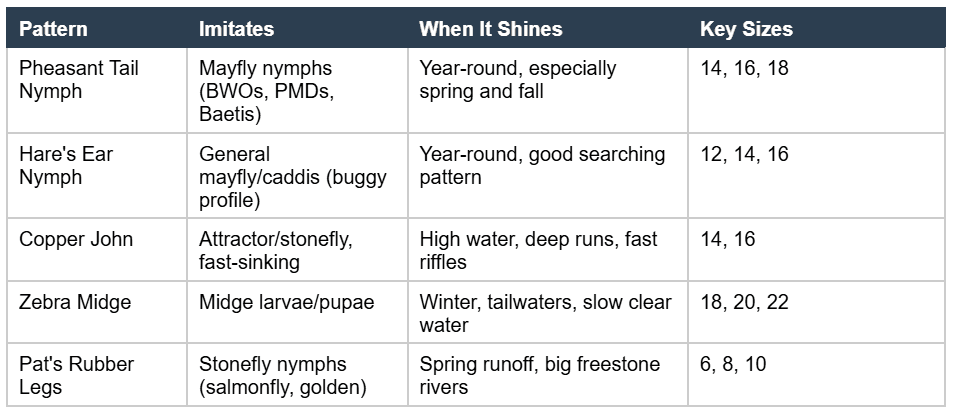
A two-fly nymph rig using a Copper John as the heavy point fly and a Pheasant Tail or Hare's Ear as the dropper will catch trout on virtually any river in Colorado, Wyoming, or Montana. If that rig is not working, switch the dropper to a Zebra Midge before changing anything else. Trout eat more midges than any other single food item, and most anglers underestimate how often a tiny midge outfishes a larger pattern.
The Mistakes That Kill Your Drift
Not Fishing Deep Enough
The number one nymphing mistake is fishing above the fish. Trout hold near the bottom in moving water, and your flies need to be within 6-12 inches of the bottom to be in the feeding zone. If your indicator is never pausing or your flies never tick a rock, you are too shallow. Add weight or move the indicator further from the fly until you start making occasional contact with the bottom.
Setting the Hook Too Late
In nymph fishing, you set the hook on anything that looks wrong. The indicator dips, hesitates, moves sideways, or does anything other than drift at current speed -- set the hook. Most nymph takes feel like nothing at all. A trout eats a drifting nymph by opening its mouth and letting the fly wash in, then spits it within a fraction of a second. If you wait until you feel the pull, the fish is already gone. Develop the habit of setting on everything suspicious. You will set the hook on rocks and sticks far more often than on fish, and that is exactly right.
Ignoring Your Mend
A mend is the upstream flip of your fly line that removes drag from the drift. In nymph fishing, a good mend is the difference between a natural drift and a fly that swings unnaturally across the current. Mend immediately after the cast and continue micro-mending throughout the drift to keep the indicator traveling at the same speed as the current. If your indicator is moving faster than the bubbles around it, you have drag. Mend upstream and let the rig settle.
Putting It Together on the River
Start with indicator nymphing. It is the most forgiving technique and teaches you the fundamentals -- reading water, achieving a natural drift, and detecting strikes. Once you can consistently dead-drift a nymph through a run and hook fish on the indicator dip, you have the foundation for everything else. Euro nymphing builds on those skills with more sensitivity and closer-range control. The dry-dropper is your summer fun rig when hatches are happening and you want to cover both options.
The one thing all three techniques share is that they reward time on the water more than anything you can buy. A $3 Pheasant Tail drifted through the right seam at the right depth will outfish a $3 Pheasant Tail drifted through the wrong water at the wrong depth, every single time. Learn to read the river first, and the fish will follow.
And when you are ready to fish water where the trout are not educated by a parade of other anglers, private access is the difference between a good day and a great one.
Better nymphing starts with better water. Infinite Outdoors has private rivers and spring creeks across Colorado, Wyoming, and Montana -- mapped access points, healthy wild trout populations, and the kind of structure that holds fish in every run. Book your next fishing day at infiniteoutdoorsusa.com
Frequently Asked Questions
Q: How deep should I fish nymphs for trout?
A: Your flies should drift within 6-12 inches of the bottom. Set your indicator at 1.5 times the water depth as a starting point. If you are never touching bottom, add weight or increase the distance between the indicator and the fly. Occasional bottom contact means you are in the zone.
Q: Can I nymph fish with a regular fly rod?
A: Yes. A standard 9-foot 5-weight rod handles indicator nymphing and dry-dropper rigs perfectly. You can also Euro nymph with it by extending your leader to 15-20 feet. A dedicated 10-foot Euro rod improves sensitivity and reach but is not required to start.
Q: What is the difference between Euro nymphing and indicator nymphing?
A: Indicator nymphing uses a float to detect strikes and suspend flies at a set depth. Euro nymphing uses no indicator -- you maintain direct contact with your flies through a tight line and detect strikes by feel or by watching a colored sighter. Euro nymphing offers more sensitivity and a more natural drift but requires closer range and more active technique.
Q: How do I know which nymph pattern to use?
A: Start with a Pheasant Tail or Hare's Ear in size 16 -- these imitate the most common trout food in nearly every river. If those are not working, switch to a smaller Zebra Midge. If you can see insects in the water, try to match their size and color. When in doubt, go smaller and darker.
Q: Why am I not catching fish while nymphing?
A: The three most common reasons are: you are not fishing deep enough (add weight), your drift has drag (mend upstream more aggressively), or you are setting the hook too late (set on every suspicious indicator movement). Fix those three things before changing flies.