Colorado Elk Hunting: OTC Tags, Draw Units & Private Land Access


Mateo Lorenzo
10/09/2026
Colorado is where many elk hunters cut their teeth and started chasing bulls on an easy to get OTC tag, whether that be with a bow or rifle. As the years have progressed, pressure, hard winters, and other factors have forces the Colorado Parks and Wildlife’s decision makers to alter how it distributes tags to both residents and non-residents alike. No changes, however, have been bigger than the reduction in NR archery OTC tags, and the shuffling of units during the 2nd and 3rd seasons. Here is our breakdown of what those changes mean and how to navigate them to be successful on your next Colorado elk hunt.
Want to hunt Colorado elk on private land this fall? Infinite Outdoors has ranches in prime elk units across the state -- low pressure, healthy herds, and no lottery required. Browse Colorado elk properties at infiniteoutdoorsusa.com
Why Colorado for Elk?
Colorado holds the largest elk herd in North America -- roughly 280,000 animals across the state according to the most recent state data. It offers more elk hunting opportunities than any other state, with a diverse mix of over-the-counter tags, limited draw units, and both public and private land access. For non-residents, Colorado is one of the only Western states where you can decide in October to hunt elk the same month and actually have a tag in your pocket. That accessibility is the main draw, and it is the reason Colorado sells more non-resident elk licenses than any other state.
But Colorado's popularity is also its challenge. OTC units see significant hunting pressure, especially during 2nd and 3rd rifle seasons. Understanding which tags are available, when the seasons run, and how to find less-pressured ground is the difference between a productive hunt and a frustrating one.
Hunt private land with Access+. Start your 7-day trial for day access to private properties across the US. Start your 7-day trial →
The OTC Landscape: What Changed in 2025-2026
Colorado Parks and Wildlife made two major changes that reshape how non-residents access elk hunting:
Change 1 (2025): Non-resident OTC archery elk west of I-25 is gone. Starting in 2025, all non-resident archery elk licenses for units west of I-25 and GMU 140 moved into the draw. This eliminates the OTC purchase that non-residents relied on for decades. However, in the first year of the new system, nearly all archery elk tags went to leftover sales after the draw, meaning tags were still available -- just through a different process.
Change 2 (2026): OTC rifle bull elk removed from GMUs 54, 55, and 551. The Gunnison Basin units lost their OTC 2nd and 3rd season rifle bull tags for 2026. On the positive side, fifteen units in northwest Colorado containing the White River herd were added back to OTC rifle area for 2nd and 3rd season.
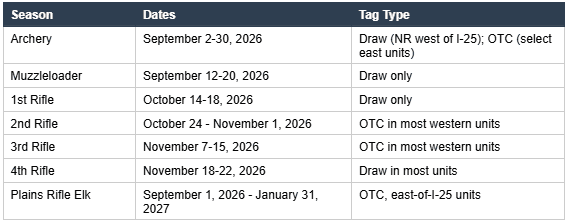
What still works: OTC 2nd and 3rd season rifle bull elk tags remain available in the majority of units across western Colorado. These are the primary OTC opportunity for non-residents in 2026. Plains units also offer OTC rifle elk with extended seasons running September through January however these consist primarily of private land. Infinite Outdoors does offer some OTC hunts east of I-25 in these units.
Understanding Colorado's Tag Types
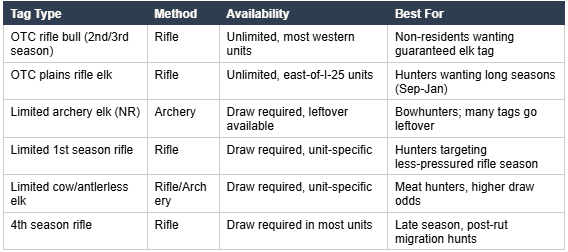
If You Have an OTC Rifle Tag
The 2nd rifle season (October 24 - November 1, 2026) and 3rd rifle season (November 7-15, 2026) are the OTC window for non-residents in western units. Here is what to expect and how to approach it:
The Reality of OTC Pressure
Second rifle season is the most heavily hunted period in Colorado. Every non-resident with an OTC tag, every Colorado resident who did not draw a limited tag, and every outfitter client hunting OTC converges on the same units at the same time. Trailheads are packed, elk move to the thickest timber they can find, and the animals that survived archery and 1st rifle season are already educated. This is not a reason to skip the hunt, however private land access can often give you the upper hand during these busy seasons.
How to Find Less-Pressured Ground
On public land, the best OTC strategy is getting away from roads and trailheads. Elk in pressured units move deeper into timber and higher into difficult terrain as the season progresses. Hunters willing to hike 3+ miles from a road and camp in the backcountry see dramatically less competition. The other option is private land. During 2nd and 3rd rifle season, elk are moving between high-country summer range and lower-elevation winter range. That migration often crosses private ranch land in the valley bottoms, and the elk that reach private ground face far less pressure than those on adjacent public land.
OTC elk hunting on public land means competing with thousands of other tag holders. Private ranches in Colorado offer the same OTC tag flexibility with a fraction of the pressure. Infinite Outdoors has elk properties across Colorado -- browse availability for 2nd and 3rd rifle season at infiniteoutdoorsusa.com
If You Are Applying for the Draw
Colorado's draw system uses preference points for elk, deer, and antelope. Non-residents receive up to 20% of limited licenses in units where residents need 6+ points to draw. The 2026 application window ran March 1 through April 7, with results released May 26-29.
Important upcoming change: Colorado's point system shifts to a hybrid bonus-plus-preference model starting in 2028. Under the new system, half of the limited tags will go to the highest-point holders (preference) and half will be distributed randomly with points acting as bonus entries (more points = more chances, but no guarantee). If you are sitting on high points for a premium unit, consider using them before 2028 when the system becomes partially randomized.
Best Draw Strategy for Non-Residents
For non-residents building points, the most practical approach is to apply for a premium limited unit as your 1st choice (building points toward your dream hunt) and choose a leftover-eligible archery elk code as your 2nd choice. If you do not draw your 1st choice, the 2nd-choice archery tag often goes to leftover anyway, and you can buy an OTC rifle tag separately. This way you build points toward a limited hunt while still having a tag in your pocket every year.
What It Costs
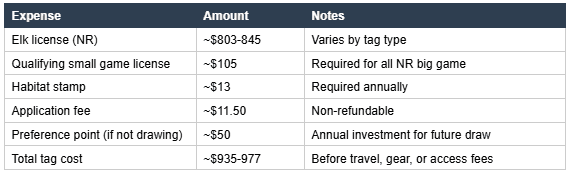
Source: CPW 2026 fee schedule. A budget DIY trip typically totals $1,400-1,900 including tag, gas, food, and camping. A standard DIY trip with lodging runs $2,600-4,800. Guided hunts range from $6,700 to $10,500+ depending on unit and outfitter.
2026 Season Dates at a Glance
The Private Land Advantage in Colorado
Colorado has more elk than any state but also more elk hunters than any state. The math is straightforward: wherever public land is accessible by road, it gets heavy pressure during rifle season. Elk respond by shifting to private land where they face less disturbance. Ranches in the valleys and transition zones between public high country and private valley bottoms become natural elk holding areas from October through December.
For non-residents hunting OTC, private land access is the single most effective way to improve your hunt without spending years in the draw. You use the same OTC tag, hunt the same season, but you are on ground where the elk are not running from other hunters. The combination of an affordable OTC tag and a quality private land booking is often a better value proposition than spending $6,000-10,000+ on a guided hunt in a limited draw unit.
Colorado elk hunting does not have to mean fighting crowds on public land. Infinite Outdoors has private ranches in western Colorado elk units -- biologist-certified herds, mapped access, and the kind of low-pressure ground that makes OTC tags worth carrying. Plan your fall hunt at infiniteoutdoorsusa.com
Frequently Asked Questions
Q: Can a non-resident buy an over-the-counter elk tag in Colorado?
A: Yes. Non-residents can still buy OTC rifle bull elk tags for the 2nd and 3rd rifle seasons in most western Colorado units. Non-resident OTC archery elk is no longer available west of I-25 as of 2025 -- those tags moved to the draw, though many go to leftover sales.
Q: How much does a non-resident Colorado elk tag cost?
A: The total cost for a non-resident elk tag including the qualifying small game license, habitat stamp, and application fee is approximately $935-977 for the 2026 season.
Q: What is the best rifle season for Colorado elk?
A: The 3rd rifle season (November 7-15) often produces the best combination of elk movement and slightly less pressure than 2nd season. Cold weather and early snow push elk into migration patterns that make them more visible and more predictable. First rifle season has the least pressure but requires a limited draw tag.
Q: Do I need preference points for Colorado elk?
A: Not for OTC rifle tags. You can buy an OTC 2nd or 3rd season rifle bull tag with zero points. For limited draw units, non-residents typically need 3-10+ preference points depending on the unit and season. Premium units like GMU 61 or 76 can require 15+ points.
Q: Is Colorado switching its point system?
A: Yes. Starting in 2028, Colorado will move from a pure preference point system to a hybrid bonus-plus-preference model. Half of limited tags will go to highest-point holders and half will be randomly distributed with points as bonus entries. Hunters with accumulated points should consider using them before the change takes effect.