Colorado Turkey Hunting: Spring Season, Units & Private Land Access


Mateo Lorenzo
04/06/2026
Colorado offers three turkey seasons — spring (April 11–May 31), fall, and a late private-land-only season. The state holds both Merriam’s and Rio Grande subspecies across mountain forests and eastern plains. Licensing runs through a draw-plus-OTC system, and spring hunters can harvest two bearded birds if limited licenses are drawn. Private land access is the fastest path to low-pressure birds that still respond to calling.
Spring turkey season is open in Colorado — and private land is where you’ll find birds that haven’t heard every box call in the county.
Infinite Outdoors has vetted turkey properties across Colorado’s best units, from the Gunnison Basin to the eastern plains.
Browse Colorado turkey properties → infiniteoutdoorsusa.com
Colorado Turkey Hunting: Spring Season, Units & Private Land Access
Colorado is one of the better-kept secrets in spring turkey hunting. The state gets overshadowed by traditional powerhouses like Missouri, Kansas, and Pennsylvania, but hunters who know where to look find excellent bird numbers, two distinct subspecies, and — critically — far less hunting pressure than most Eastern and Midwestern states. In 2024, Colorado hunters harvested 5,903 turkeys (source: NWTF/Realtree 2026 Western Turkey Forecast). With a licensing system that blends limited draw tags with over-the-counter options, and three separate seasons spread across nine months of the year, the state offers more flexibility than most hunters realize.
This guide covers everything you need to plan a Colorado turkey hunt in 2026: season dates, licensing, subspecies ranges, the best regions to target, and why private land access is the single biggest factor separating a great hunt from a frustrating one.
What Are Colorado’s Turkey Season Dates for 2026?
Colorado runs three distinct turkey seasons, each with different bag limits and weapon restrictions. Here is the 2026 breakdown:

*Fall dates vary by unit — west of I-25 and GMU 140 close earlier than eastern units. Always confirm your specific GMU dates in the 2026 CPW Turkey Brochure.
The spring season is the main event for most turkey hunters. You are chasing gobblers during the breeding season, when toms are vocal and responsive to calling. Spring is shotgun and archery only, including crossbows. The fall season allows either-sex harvest and all legal weapons, making it a good option for hunters who want to use a rifle or who prefer working scattered flocks rather than calling in gobblers. The late season is private-land-only and targets beardless birds, a conservation management tool that doubles as an extended hunting opportunity for landowners and those with private access.
That private-land-only late season is worth highlighting: it means hunters with access to private land get an entire extra month of turkey hunting that public land hunters do not.
How Does Colorado Turkey Licensing Work?
Colorado uses a draw-plus-OTC system for turkey. In the spring, limited licenses are issued through a draw process. Hunters who do not draw a limited tag — or who want a second bird — can purchase an over-the-counter license that covers all OTC-eligible GMUs statewide. That means you can hunt one unit on Saturday and drive to a completely different unit on Monday.
To reach the spring two-bird limit, you need both a limited draw license and an OTC license. Non-residents should be aware that turkey licensing requires a qualifying upland game bird license (approximately $110 for non-residents, $85 for residents) before purchasing individual turkey tags. Youth under 18 can apply for reduced-cost licenses through the draw.
The primary draw application deadline for 2026 has already passed, but leftover licenses are available now through CPW’s reissue system — reissue preview lists are posted Tuesdays at 11:00 a.m. MT, with sales opening on Wednesdays. If you missed the draw, leftover tags are your best path into the spring season. Plus you can still pick up OTC tags before and during the season.
Public parcels you can't legally reach without crossing private ground? Access+ includes passage through landowner agreements. Start your 7-day trial →
Merriam’s vs Rio Grande: Two Birds, Two Hunts
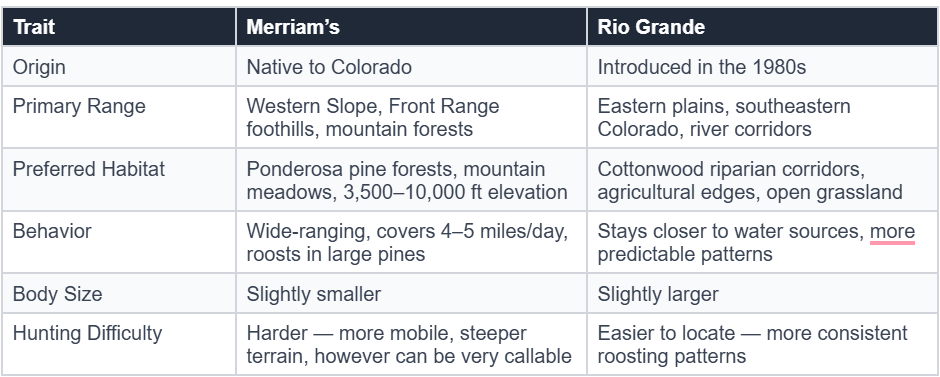
Colorado is one of a handful of states where you can hunt both Merriam’s and Rio Grande turkeys in the same season, often within a two-hour drive of each other. Understanding where each subspecies lives — and how they behave — makes a real difference in how you plan your hunt.
Hunting Merriam’s in the Mountains
Merriam’s are Colorado’s native wild turkey, and hunting them is a fundamentally different experience from Eastern or Rio Grande hunting in flatter states. These birds live in mountainous terrain — ponderosa pine forests, mixed conifer stands, and mountain meadows between 3,500 and 10,000 feet. They are wanderers. A tom working a ridge in the morning may be two miles away by midday. Be prepared to cover ground.
The best Merriam’s hunting in Colorado is concentrated on the Western Slope and Front Range foothills.. The Gunnison Basin is consistently one of the top areas in the state, especially where pine forests and mountain meadows intersect. The San Juan, Arkansas, Rio Grande, and Animas river valleys also hold strong populations. On the Front Range, you will find pockets of Merriam’s in the foothills, but hunting there tends to involve more pressure, private land, and less predictable birds.
A practical tip: Merriam’s roost in large ponderosa pines. If you can identify roost trees the evening before and set up within 150 yards at first light, your odds improve significantly. These birds typically fly down, gobble, and move — fast. If you are not in position early, you are chasing them uphill.
Hunting Rio Grande on the Plains
Rio Grande turkeys were introduced to Colorado in the 1980s and have thrived on the eastern plains and in southeastern Colorado. These birds prefer cottonwood riparian corridors, agricultural edges, and open grassland near water. Compared to Merriam’s, Rios are slightly larger, stay closer to their core area, and are generally easier to pattern day to day.
If you are a first-time Colorado turkey hunter, Rio Grande country on the eastern plains may be the smarter starting point. The terrain is more forgiving, the birds are more predictable, and you can cover more ground with less elevation gain. Popular counties for Rio Grande turkey hunting include Yuma, Prowers, Las Animas, and Baca — all in the southeastern quadrant of the state.
The tradeoff: eastern plains can mean less public land access. Much of the best Rio Grande habitat sits on private agricultural land. This is where access becomes the defining variable.
The best Colorado turkey hunting happens on private land where birds haven’t been pressured all season.
Infinite Outdoors has biologist-vetted turkey properties across the state — from Merriam’s country on the Western Slope to Rio Grande habitat on the eastern plains. No lease, no outfitter — book by the day.
Find Colorado turkey properties → infiniteoutdoorsusa.com
Where Should You Hunt Turkey in Colorado?
Colorado is a big state, and turkey distribution is not uniform. Here is a regional breakdown to help you narrow your search:
Western Slope (Merriam’s)
The Gunnison Basin is the crown jewel for Merriam’s hunting. Pine forests and open meadows create classic strut zones. The Uncompahgre Plateau and the San Juan river corridor also hold huntable populations. This is rugged, vertical country — plan for elevation and weather swings. April in the Gunnison Basin can go from 60 degrees and sunny to a foot of snow overnight.
Front Range Foothills (Mixed)
The foothills west of Denver, Colorado Springs, and Pueblo hold both Merriam’s and some Rio Grande birds in the transition zone. Access is tighter here — private land dominates the foothills, and public parcels tend to get heavy pressure early in the season. If you can secure private access in the Front Range corridor, the hunting can be excellent because the birds see fewer hunters.
Eastern Plains (Rio Grande)
Southeastern Colorado is the heart of Rio Grande country. Cottonwood bottoms along the Arkansas River and its tributaries hold strong populations. This is agricultural landscape — cattle ranches and crop fields interspersed with shelterbelts and riparian corridors. Access is predominantly private, and the hunters who do well here are the ones who have built landowner relationships or secured private access through a platform.
Why Private Land Access Matters for Colorado Turkey Hunting
Turkey hunting is arguably the species where the difference between public and private land is most dramatic. Turkeys pattern to specific roost sites, strut zones, and feeding areas. On public land — especially in popular Front Range units — those patterns get disrupted fast once multiple hunters start working the same birds in the first week of the season. Gobblers that were screaming on the opener go silent by week two.
On private land with limited access, those birds stay on their natural patterns all season. They roost in the same trees, strut in the same meadows, and respond to calling the way turkeys are supposed to. This is not a minor edge — it is the difference between hearing gobbles at first light and sitting in silence wondering where the birds went.
Colorado’s late season (December 15 through January 15) is private-land-only by regulation. That means the state itself recognizes private land as a separate management tool for turkey. If you have access, you get an entire extra season that public-land hunters cannot participate in.
The traditional route to private land turkey access in Colorado has been cold-knocking on ranch doors or committing to a long-term lease. Both work, but both have friction: cold-knocking is hit-or-miss, and leases lock you into a single property for a full year whether the birds are there or not. Booking platforms now offer a third path — confirmed access to vetted private properties on a per-day or per-trip basis, without the commitment of a lease or the uncertainty of showing up at a stranger’s gate.
Gear and Preparation Tips for Colorado Turkey
Colorado turkey hunting comes with a few considerations that differ from hunting flatter, warmer states:
Weather layering is essential. Spring mornings in the mountains can start at 25 degrees and climb to 65 by noon. Bring a packable insulated layer you can shed mid-morning without leaving your setup.
Boots matter more than your call selection. Merriam’s country means steep terrain and loose rock. A good pair of mid-weight hunting boots with ankle support will serve you better than a new mouth call. Rio Grande country on the plains is flatter but can involve muddy creek bottoms and agricultural fields after rain.
Colorado weather in April and May is notoriously unpredictable. A late-spring snowstorm is not unusual in the mountains, and it can actually improve your hunt — turkeys bunch up near lower-elevation food sources when snow pushes them off the ridges.
Regarding ammunition, the spring season is shotgun-only. If you are running TSS or tungsten loads, be aware that prices have risen sharply heading into 2026 — premium 18 g/cc TSS is running $20–22 per shell. Mid-density options like Winchester Long Beard Tungsten (17 g/cc) offer strong performance at a lower price point. For pre-season patterning, lead loads like Winchester Long Beard XR at $2.60–3.20 per shell save you from burning expensive tungsten at the range. Pattern your gun at 20, 30, and 40 yards with the exact load you plan to carry.
Frequently Asked Questions
Can non-residents turkey hunt in Colorado?
Yes. Non-residents can apply for limited draw tags and purchase OTC turkey licenses. You will need a qualifying upland game bird license first (approximately $110 for non-residents), then individual turkey tags on top of that.
Can you use a rifle for turkey hunting in Colorado?
Not during the spring season. Spring is restricted to shotguns, archery, and muzzleloaders. Rifles and handguns are legal during the fall and late seasons only.
What is the bag limit for spring turkey in Colorado?
Two bearded turkeys in the spring. You need a limited draw license for one and an OTC license for the second. Both must be bearded birds (gobblers or occasionally bearded hens).
What is the best area for turkey hunting in Colorado?
For Merriam’s, the Gunnison Basin and the river valleys of the Western Slope. For Rio Grande, the southeastern plains — particularly along the Arkansas River corridor and in counties like Yuma, Las Animas, and Baca. Access is the key variable in both regions.
Is Colorado’s late turkey season worth hunting?
If you have private land access, yes. The late season (December 15 through January 15) is private-land-only and allows two beardless birds. Turkeys concentrate near food sources in winter, making them easier to locate. It is a low-pressure, overlooked season.
The Bottom Line
Colorado turkey hunting flies under the radar nationally, and that is part of what makes it good. Two subspecies, three seasons, and a licensing system flexible enough to get you in the field even if you miss the draw. The state has solid bird numbers — nearly 6,000 harvested in 2024 — and nowhere near the hunting pressure of the major Midwestern turkey states.
The variable that separates a productive Colorado turkey hunt from a frustrating one is access. Public land can produce, especially early in the season and in less-pressured Western Slope units. But the most consistent turkey hunting — the kind where birds gobble all morning and come to the call on a string — happens on private ground with limited hunter traffic. If you can lock down private access in the units you want to hunt, you are ahead of most hunters in the state.
Spring season is open right now — and leftover tags are still available.
Infinite Outdoors connects you with private turkey properties across Colorado: biologist-vetted, low-pressure, and bookable by the day. No lease commitment, no outfitter markup. Merriam’s on the Western Slope and Rio Grande on the plains.
Browse Colorado turkey hunting access → infiniteoutdoorsusa.com