Why the 20 Gauge Shotgun Is Becoming the New Standard for Fall Hunting


Justin Hunold
06/26/2026
Summer can make hunting season feel comfortably distant. Turkey tags have been folded into wallets or tucked into filing cabinets, the last muddy boots of spring are finally dry, and the woods have grown so thick that November seems like another lifetime.
It is not.

Dove fields are already taking shape. Young birds are moving through fence rows and shelterbelts. Waterfowl hunters are checking decoy lines, repairing blinds, and pretending the dog will somehow remember everything it learned last season. Before long, early goose dates will arrive, followed by duck openers, pheasant walks, rabbit drives, and cold mornings spent listening for squirrels in the hardwoods.
A 20 gauge shotgun has become a versatile choice for modern hunters thanks to lighter weight, reduced recoil, and improved ammunition. With the right choke and load, it can effectively handle doves, ducks, geese, upland birds, turkeys, rabbits, and squirrels while remaining easier to carry and shoot than many 12 gauge shotguns.
This stretch between spring turkey season and the first fall opener is when hunters begin sorting through gear and making decisions. Which shotgun needs a new sling? Which choke threw the best pattern last year? How many shells are left in the cabinet, and how many of them are actually the same load?
Increasingly, another question is joining that list:
Is it time to start hunting with a 20 gauge shotgun?
For generations, the 12 gauge was the default answer for nearly every shotgun season. It carried more pellets, offered more load options, and delivered enough authority for everything from September doves to January geese. The 20 gauge occupied a different category. It was commonly viewed as a youth gun, a light upland piece, or a temporary stop before a hunter moved up to a 12.
That reputation no longer matches reality.
Modern ammunition has expanded what the 20 gauge can do. Better steel loads, bismuth, tungsten-based shot, improved wads, and more effective choke systems have turned it into a serious hunting platform. It is lighter to carry, easier to shoot, and capable of handling an impressive range of birds and small game when the hunter understands its limits.
The 12 gauge is not obsolete, nor is it likely to become obsolete. There are still hunts where its larger payload and broader ammunition selection make it the better choice. But for hunters who spend their fall moving from dove fields to duck blinds, pheasant cover, goose spreads, and squirrel woods, the modern 20 gauge shotgun has become much more than a smaller alternative.
For many hunters, it is becoming the standard.
Hunt private land with Access+. Start your 7-day trial for day access to private properties across the US. Start your 7-day trial →
The 20 Gauge Has Outgrown Its Old Reputation
The 20 gauge has always been useful. What changed was not the diameter of the bore, but what manufacturers learned to put inside the shell.
Older 20 gauge loads came with obvious limitations. A smaller hull meant less room for shot. When non-toxic waterfowl regulations pushed hunters toward steel, those limitations became even more noticeable.
Steel is less dense than lead. To maintain adequate penetration on ducks and geese, hunters generally need larger steel pellets than they would use with lead. Larger pellets take up more space, which reduces the total pellet count inside a shell. That tradeoff can create thinner patterns, particularly in a smaller gauge.
The 12 gauge handled that problem by carrying a larger payload. It offered more pellets, more pattern density, and a greater margin for imperfect range estimation. For hunters using early steel loads, especially on geese or tough late-season ducks, the 12 gauge was often the practical choice.
The mistake was assuming those early performance differences defined what the 20 gauge would always be.
Ammunition technology kept moving.
Modern steel loads are faster and more consistent. Bismuth offers density much closer to traditional lead. Tungsten-based pellets are denser still, allowing smaller shot sizes to retain impressive downrange energy. Manufacturers have also improved pellet uniformity, buffering, wad design, and payload construction.
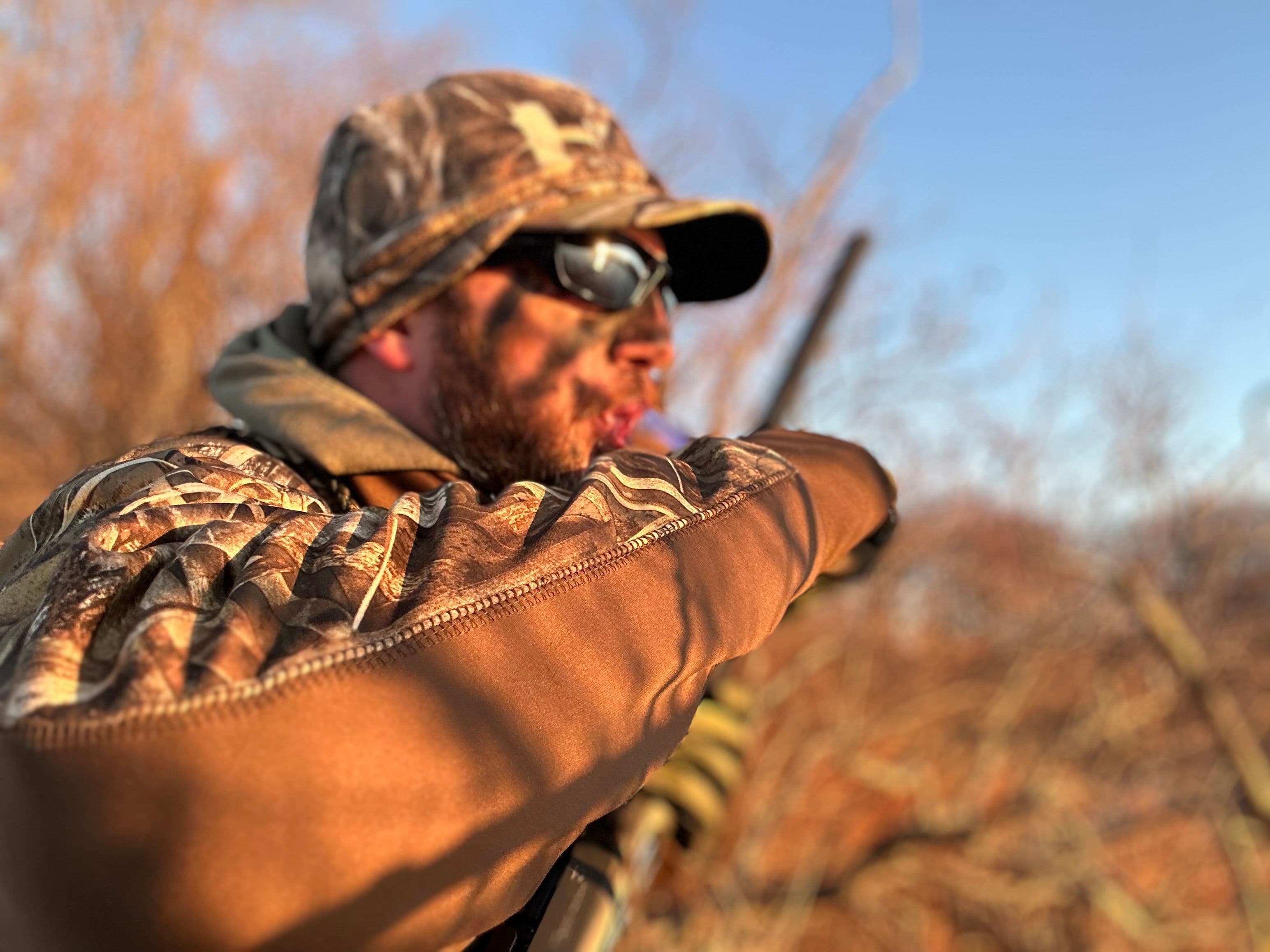
Those changes matter in every shotgun, but they are especially valuable in a 20 gauge. A smaller payload becomes far more effective when the pellets carry energy efficiently and remain evenly distributed through the pattern.
Infinite Outdoors has already explored this changing comparison in its guide to choosing between a 20 gauge and 12 gauge for waterfowl hunting. The central lesson is worth remembering: gauge alone does not determine field performance. The load, choke, range, target, and shooter matter just as much.
The modern 20 gauge is not equal to a 12 gauge in every situation. It does not need to be.
It only needs to perform cleanly and consistently within the conditions where a hunter chooses to use it.
Why More Hunters Are Choosing a 20 Gauge Shotgun
Ballistic improvements explain part of the 20 gauge’s growth, but they are not the whole story. The shotgun also fits the way many hunters approach fall seasons.
A September dove hunt may involve a short walk to a field edge and several boxes of shells. A pheasant hunt may require miles of walking through thick grass. A duck hunt may involve carrying gear through mud, climbing into a small blind, and swinging from an awkward seated position. Rabbit and squirrel hunters may spend an entire day moving through brush, creek bottoms, and hardwood ridges.
A lighter shotgun begins to make sense quickly.
Most 20 gauges are easier to carry than comparable 12 gauges. They are often quicker to mount in tight cover, more comfortable inside small blinds, and less tiring during long upland walks. They also tend to produce less recoil when comparable shotgun weights and sensible hunting loads are used.
Less recoil has practical value. It helps hunters maintain their cheek weld, follow through the shot, and recover for a second target. It also encourages practice, which is far more important than the number stamped on the barrel.
A hunter who fires a 20 gauge smoothly and confidently will usually perform better than a hunter who braces for the recoil of a heavier gun. That is true for young shooters, experienced hunters, smaller-framed adults, and anyone who has spent enough years hunting to care more about results than appearances.
There is also something appealing about simplicity.
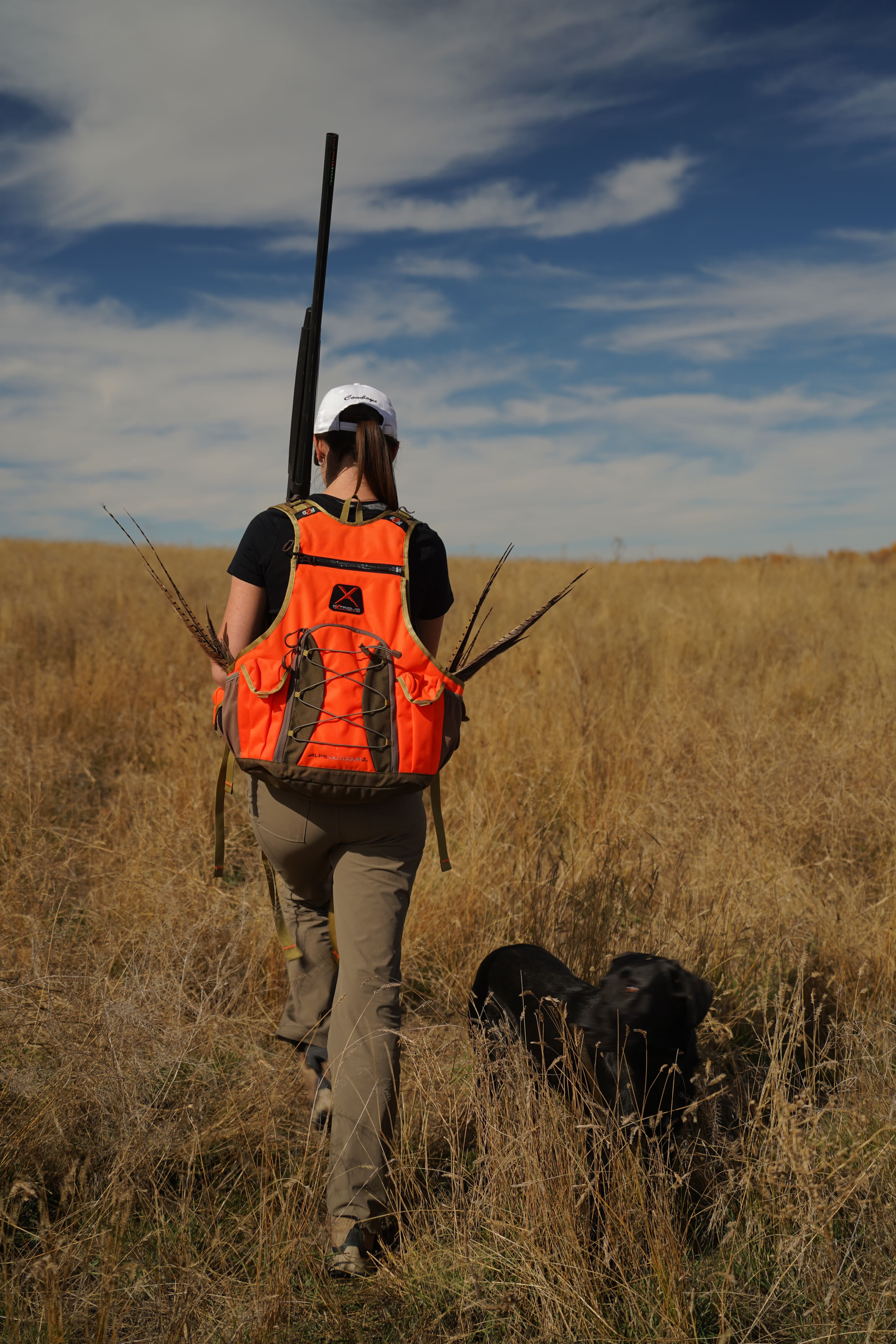
A single 20 gauge can cover doves, ducks, upland birds, squirrels, rabbits, turkeys, and carefully managed goose hunts. Changing the shell and choke allows the same shotgun to move through much of the hunting calendar.
For hunters who would rather invest in ammunition, travel, dogs, decoys, or quality private hunting access, that versatility has real value.
Dove Season Is Where the 20 Gauge Shines
Dove hunting may be the perfect introduction to the modern 20 gauge.
Doves are small, fast, and gifted at making competent shooters look foolish. They approach from behind, slide across the wind, flare at the edge of range, and change direction at precisely the moment a hunter commits to the swing.
Success depends on a smooth mount, a focused eye, and clean follow-through. Raw payload is less important than placing an even pattern in the right place.
That is exactly where a 20 gauge performs well.
A light shotgun moves easily from one bird to the next. Reduced recoil helps hunters stay composed during high-volume shooting, especially when birds arrive in waves. The difference becomes noticeable after several boxes of shells, when poor gun fit and hard recoil begin to show up as lifted heads, rushed shots, and bruised shoulders.
For most dove situations, a 20 gauge loaded with No. 7 1/2 or No. 8 lead shot is highly effective where lead is legal. Hunters using non-toxic ammunition should choose a purpose-built dove load and confirm its pattern before opening day.
Choke selection should match the setup.
Improved cylinder works well over close waterholes, small fields, and tight flight lines. Modified may be a better choice when birds are crossing wider fields or staying near the outer edge of comfortable range.
The goal is not to create the tightest possible pattern. It is to produce an even pattern that gives the hunter enough room to connect without leaving large gaps.
Dove season also exposes an important truth about shotgun hunting: carrying more pellets does not correct poor form. The shooter still has to read the bird, move the muzzle, and finish the swing.
A 20 gauge makes those fundamentals easier to practice without unnecessary punishment.
Modern Loads Have Made the 20 Gauge a Legitimate Duck Gun
Duck hunting was once considered nearly exclusive territory for the 12 gauge. That assumption made sense when steel shot options were limited and smaller gauges struggled to deliver enough pellet density with larger shot.
Today, a well-patterned 20 gauge is a legitimate duck gun.
Steel remains the most affordable and widely available non-toxic option. When paired with appropriate pellet sizes and sensible shot distances, modern 20 gauge steel loads can perform very well on decoying birds.
Bismuth and tungsten-based loads expand that performance. Their greater density allows manufacturers to use smaller pellets without sacrificing penetration, which increases the number of pellets in the payload. More effective pellets and better pattern density can make a 20 gauge surprisingly capable in flooded timber, marsh potholes, shallow wetlands, and field edges.
That does not mean every 20 gauge load will perform well in every gun.
Waterfowl hunters should test the exact shell and choke combination they intend to carry. A load that looks impressive on the box may pattern poorly through a particular barrel. Another load may produce an even, reliable pattern with a less restrictive choke.
Infinite Outdoors’ duck season preparation guide covers the larger gear picture, including non-toxic ammunition, waders, decoys, and dependable shotguns. The 20 gauge fits naturally into that system when hunters match the equipment to the conditions.
It is especially useful in close, controlled setups.
In flooded timber, a shorter and lighter shotgun is easier to maneuver around trees and brush. In a layout blind, it is easier to bring into position without excessive movement. During long walks through mud or cattails, every pound saved becomes more valuable.
The 20 gauge is less forgiving when ducks remain far outside the decoys. That is not necessarily a disadvantage. It may encourage the hunter to improve concealment, adjust the spread, call more carefully, and wait for birds to finish.
Those improvements will kill more ducks than changing gauges.
Hunters searching for productive places to apply those tactics can also review Infinite Outdoors’ guide to finding and evaluating private duck hunting land. A good location and a disciplined setup will always matter more than trying to stretch a marginal shot.
Can a 20 Gauge Shotgun Handle Geese?
A 20 gauge can kill geese cleanly, but the answer requires more context than a simple yes.
Geese are large birds with dense feathers, heavy muscle, and substantial bones. They demand enough penetration to reach vital organs, and their size makes poor range judgment especially costly.
The 20 gauge performs best when the hunt is designed around close shots.
Early-season resident geese, smaller Canada geese, and birds committed over a well-built field spread are realistic targets for modern 20 gauge ammunition. Steel can work within proven ranges, while bismuth and tungsten-based loads offer better density and energy retention.
The key is to make the birds finish.
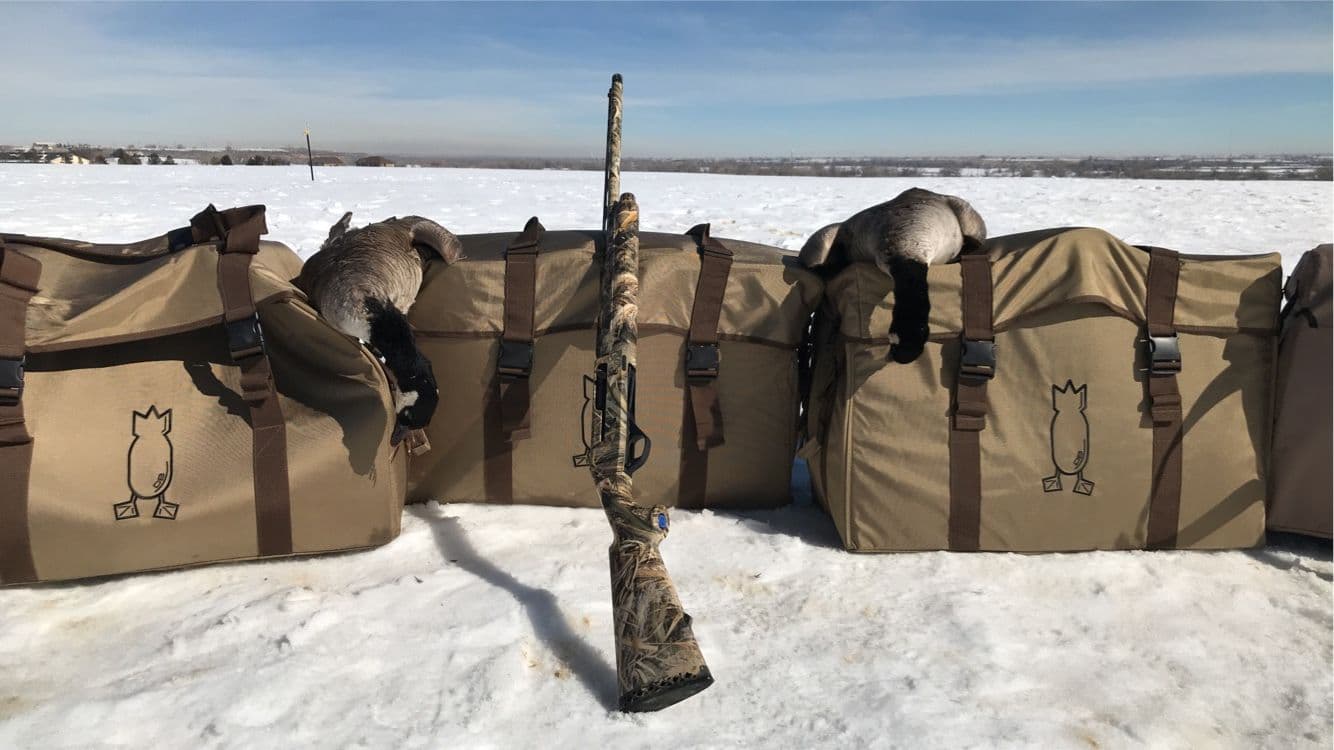
A goose hanging over the landing zone at 25 yards presents a much different target than one sliding across the edge of the spread at 50. The first is a reasonable opportunity for a properly loaded 20 gauge. The second may expose the limits of both the payload and the shooter.
This is where hunting skill matters more than shell length.
Good concealment, realistic decoy spacing, disciplined calling, and correct wind placement can bring birds into the effective range of almost any suitable shotgun. Poor setups force hunters into longer, lower-percentage shots.
Infinite Outdoors’ guide to goose hunting gear and late-season strategies discusses shotguns, ammunition, blinds, and the mental discipline required when educated birds become difficult to finish. Those principles matter even more for hunters carrying a 20 gauge.
A 12 gauge remains the more forgiving choice for large geese, open-water shooting, high winds, or situations where birds consistently remain beyond close decoy range. Its larger payload provides more pattern density and a greater margin for error.
That does not make the 20 gauge inadequate. It simply means the hunter has to be honest about the conditions.
Modern ammunition has expanded the 20 gauge’s capability, but it has not repealed physics.
The 20 Gauge Remains One of the Best Upland Guns Ever Made
Long before the 20 gauge became fashionable in turkey camps and duck blinds, it had already earned its place in the uplands.
A proper upland shotgun should be light enough to carry all day, balanced enough to move naturally, and fast enough to meet a bird that appears without warning. The 20 gauge checks those boxes better than most platforms.
For quail, grouse, woodcock, and prairie birds, it offers all the performance a hunter needs without unnecessary weight. Open chokes and smaller shot can create broad, useful patterns at close range, while more restrictive chokes and heavier loads can extend the gun’s usefulness into open cover.
Pheasants create a more complicated argument.

Early-season roosters over dogs are well within the capability of a 20 gauge. Late-season birds in heavy wind, thick cover, or open country can demand more penetration and tighter patterns. Quality plated lead, bismuth, or other dense shot options help, but the hunter still has to respect range.
Again, handling may prove more important than payload.
A lighter shotgun is often mounted more quickly. It is easier to carry at the ready, easier to swing through a crossing bird, and less likely to remain pointed at the ground when a rooster explodes from cover.
The extra payload of a 12 gauge does little good when the hunter is late to the shot.
For the hunter who spends full days following dogs through grass, brush, and broken country, a well-balanced 20 gauge can feel less like a compromise and more like the correct tool.
Small Game Keeps the 20 Gauge Working All Winter
Squirrel and rabbit seasons rarely receive the attention given to deer, elk, or waterfowl, but they remain some of the best opportunities on the hunting calendar.
They also fit the 20 gauge perfectly.
A 20 gauge carries enough shot to produce reliable patterns on small game without unnecessary recoil. It is easy to carry through hardwood ridges, creek bottoms, brush piles, and old fence lines, and it handles quickly when an animal moves through cover.
For squirrels, No. 5 or No. 6 shot is a common starting point, depending on the height of the trees, thickness of the canopy, and expected range. Rabbit hunters often use No. 6 or No. 7 1/2 shot, with improved cylinder or modified chokes selected according to the density of the cover.
The 20 gauge also makes an excellent training tool.
Small game hunting builds many of the same skills needed for fall bird seasons. Hunters learn to mount the shotgun smoothly, judge distance, track a moving target, and make quick decisions without rushing.
A winter spent chasing rabbits can improve a hunter’s shooting more than months of talking about chokes and pellet energy.
It also extends the value of the shotgun.
A 20 gauge purchased for doves in September does not have to return to the safe after duck season. It can keep hunting through the winter and return to the turkey woods in spring.
Turkey Hunting Helped Change How Hunters See the 20 Gauge
Spring turkey hunting may have done more than any other pursuit to change the reputation of the 20 gauge.
The development of tungsten super shot, commonly known as TSS, showed hunters what extremely dense pellets could accomplish in smaller payloads. Because TSS is much denser than lead, manufacturers can use very small pellets that retain significant penetration while placing large numbers of pellets into the pattern.
When matched with a proper choke and carefully patterned, a 20 gauge turkey gun can produce remarkable performance.
That success forced hunters to reconsider the idea that bore diameter alone determines killing ability.
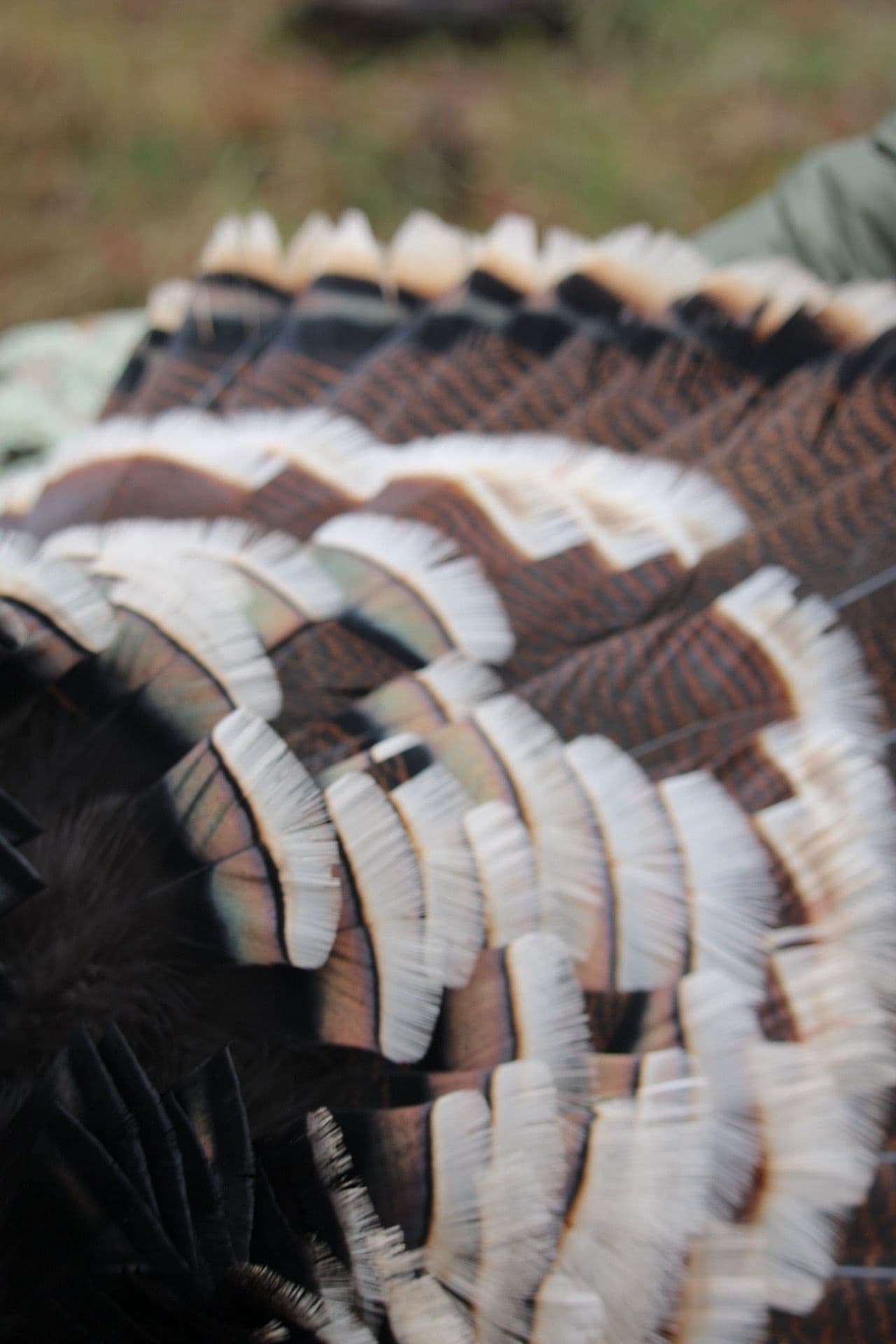
Infinite Outdoors covered this transition in its article on sub-gauge turkey guns and modern TSS loads. The same principle carries into fall seasons. Better shot materials allow smaller gauges to deliver more effective patterns than previous generations expected.
Turkey loads are specialized and should not be treated as a universal solution for every species. Still, their success changed the larger conversation.
Hunters who watched a 20 gauge perform cleanly on gobblers began to wonder what the same shotgun could do with the right duck, dove, or upland load.
The answer turned out to be quite a lot.
Recoil Is a Hunting Issue, Not a Pride Issue
Shotgun recoil has been wrapped in unnecessary pride for a long time.
Hunters talk about recoil as though ignoring it demonstrates toughness. In practice, recoil influences gun mount, cheek pressure, follow-through, confidence, and willingness to practice.
A hunter who anticipates the shot may pull the head away from the stock, close an eye, stop the swing, or slap the trigger. These mistakes often happen before the shooter consciously recognizes a flinch.
The 20 gauge generally produces less recoil than a 12 gauge when similar gun weights and appropriate loads are compared. That makes it easier for many hunters to shoot well, particularly during high-volume dove hunts or repeated clay practice.
However, a 20 gauge is not automatically soft shooting.
A very light gun firing a heavy magnum load can recoil sharply. In some cases, it can be nearly as uncomfortable as a heavier 12 gauge. Stock design and gun fit also influence how recoil feels.
A shotgun with the wrong length of pull may force the shooter into an awkward position. A poorly shaped comb can drive into the cheek. Incorrect pitch can concentrate recoil into a small area of the shoulder.
Hunters should choose a shotgun based on fit rather than assumptions.
When the gun comes to the shoulder, the eye should align naturally down the rib. The hunter should not have to crawl forward on the stock, lift the head, or roll the face sideways to find the sight picture.
Semi-automatic shotguns may reduce felt recoil by spreading the rearward force across the operating cycle. Gas-operated models are often especially comfortable, while inertia-operated guns tend to be lighter and simpler to maintain.
The best system depends on the hunter, but the principle remains the same.
A shotgun that fits and feels manageable will be shot more often and more effectively.
Choosing the Right 20 Gauge Shotgun
The modern 20 gauge is available in nearly every major action type, each suited to a different style of hunting.
Pump-Action Shotguns
Pump guns are durable, affordable, and reliable. They work well for waterfowl, turkeys, small game, and general hunting.
Their manual action requires practice. A hunter who rarely operates a pump under pressure may short-stroke it or lose rhythm during a follow-up shot. Regular clay shooting helps make the motion automatic.
For hunters who value simplicity and hard-use dependability, a pump-action 20 gauge remains an excellent choice.
Semi-Automatic Shotguns
Semi-automatic 20 gauges have become popular for doves and waterfowl because they offer quick follow-up shots and manageable recoil.
Gas-operated models are typically soft shooting, while inertia systems are often lighter and better suited to hunters who prioritize easy maintenance.
Hunters should test the shotgun with the loads they expect to use. Some semi-automatics cycle light target loads easily, while others perform best with heavier hunting ammunition.
Over-Under Shotguns
An over-under offers two barrels, two choke options, and simple operation. It is an excellent choice for upland birds, sporting clays, and dove fields.
The ability to select between a more open and tighter choke gives hunters flexibility when birds flush at different distances. The two-shell capacity is rarely a serious limitation in upland hunting, where the first shot is usually the best opportunity.
Side-by-Side Shotguns
A side-by-side 20 gauge is light, quick, and deeply tied to upland tradition.
Its wider sighting plane can feel unfamiliar to shooters raised on pumps and semi-automatics, but a well-fitted double gun handles beautifully in thick cover. It also provides instant access to two different chokes.
Single-Shot Shotguns
Single shots are simple, light, and affordable. They are useful for turkeys, squirrels, rabbits, and deliberate hunting situations.
The obvious limitation is the lack of a quick second shot. That can also become a lesson in patience and shot selection, particularly for new hunters.
Barrel Length, Weight, and Handling
A versatile 20 gauge usually wears a barrel between 24 and 28 inches.
Short barrels are convenient in turkey woods, layout blinds, boats, and heavy brush. Longer barrels may provide a smoother swing for doves, geese, and crossing upland birds.
Overall balance matters more than barrel length alone.
A short shotgun that carries too much weight near the muzzle may still feel slow. A longer shotgun with good balance may move naturally and remain easy to control.
Weight also creates a tradeoff.
Light shotguns are pleasant to carry, but they can be harder to swing smoothly and may produce more felt recoil. Heavier shotguns absorb recoil and tend to continue through the target, but they become tiring over long distances.
The best choice should reflect the hunt.
A grouse hunter covering steep timber may accept more recoil in exchange for a gun that disappears in the hands. A duck hunter sitting in a blind may prefer extra weight for smoother shooting.
The right 20 gauge is not necessarily the lightest one available. It is the one that carries comfortably and still moves predictably when a bird appears.
Patterning Is More Important Than Gauge
Hunters routinely spend hours confirming rifle zero, calculating bullet drop, and testing different loads. Many of those same hunters take a shotgun into the field without ever firing it at paper.
That is a mistake.
Shotguns do not throw identical patterns. The interaction between the barrel, choke, wad, pellet material, pellet size, velocity, and payload can produce major differences.
Before the season, hunters should pattern the exact load they intend to carry.
Begin at a realistic distance. Dove and upland loads might be tested at 20, 30, and 40 yards. Waterfowl hunters should concentrate on the distances at which they expect birds to finish. Goose hunters should test the farthest range they are genuinely willing to shoot, not the distance they hope a shell can cover.
Use a large sheet of paper with a clear aiming point. Fire from a stable rest so the test measures the gun and load rather than mounting inconsistency.
Evaluate more than the center of the pattern.
Look for even pellet distribution, large gaps, adequate density, and the relationship between point of aim and point of impact. Fire multiple shells because patterns vary from shot to shot.
A tighter choke is not automatically better.
Some steel and tungsten-based loads perform exceptionally well through modified or specialized waterfowl chokes. An overly restrictive choke may create uneven patterns or place too many pellets in the center while leaving the edges thin.
Pattern testing turns assumptions into useful information.
It also tells the hunter where the 20 gauge’s limitations begin.
The Limits Still Matter
The growing popularity of the 20 gauge has created its own form of exaggeration.
Modern ammunition has made the gauge more capable, but it has not made payload capacity irrelevant. A 20 gauge still carries less shot than a comparable 12 gauge load. When both shells use the same pellet size and material, the 12 gauge will generally place more pellets into the pattern.
That additional density can be valuable on geese, diver ducks, late-season pheasants, and other challenging targets.
The 12 gauge also offers a wider selection of ammunition in many stores. A hunter traveling far from home may have an easier time replacing a forgotten or lost box of 12 gauge shells.
There are also situations where a heavier shotgun helps rather than hurts. Open-water hunting, high winds, and long crossing shots may favor the smoother swing and larger payload of a 12.
The 20 gauge should not be carried because it is fashionable.
It should be carried because it matches the hunt and the shooter.
Ethical use requires knowing the load’s pattern, maintaining sensible range limits, and passing shots that do not present a clean opportunity.
Those requirements apply to every shotgun, including the 12 gauge. A larger bore does not turn a poor shot into a good one.
One Shotgun for the Fall Hunting Calendar
The strongest case for the 20 gauge shotgun is not based on a single species. It is based on the entire season.
The shotgun can begin September in a dove field with light loads and an open choke. It can move into early teal season with non-toxic ammunition, follow a bird dog through October grass, and sit beside a hunter in a November duck blind.
Later, it can travel to a goose field with dense shot, walk frozen rabbit cover, and finish the winter under a hardwood ridge waiting for squirrels.
By spring, the same shotgun can wear a turkey choke and return to the woods.
That is an unusual amount of work for one firearm.
The versatility also pairs well with the growing ability to locate and book different types of hunting ground. Infinite Outdoors offers access across multiple game categories, including waterfowl, upland birds, turkey, and small game. Hunters can use the platform to explore properties without committing to a full-season lease or relying entirely on crowded public access.
Those opportunities are most valuable when the hunter arrives prepared.
A new property may include a dove field, a pond holding ducks, and cover suitable for small game. A 20 gauge allows the hunter to adapt without hauling a different shotgun for every possibility.
Change the ammunition. Confirm the choke. Understand the rules for the species and property.
Then hunt.
Find Your Next Fall Hunt with Infinite Outdoors
A versatile 20 gauge shotgun deserves a full hunting calendar. Explore and book private dove, waterfowl, upland bird, turkey, and small game properties through Infinite Outdoors, then spend less time searching for access and more time preparing for opening day.
Find Your Next Hunt with Infinite Outdoors
Is the 20 Gauge Shotgun the New Standard?
For a growing number of hunters, it is.
The 20 gauge is lighter than many 12 gauges, produces manageable recoil, and handles naturally in blinds, grasslands, timber, and brush. Modern ammunition has made it effective for species that were once considered outside its reach.
It is an outstanding dove gun, a capable duck gun, and one of the finest upland and small game platforms available. It can handle geese when birds are brought close and the correct load is used. It has already proven itself in the turkey woods.
None of this means every hunter should sell a 12 gauge.
The 12 remains the more forgiving choice for large payloads, long waterfowl shots, hard late-season birds, and hunters who need maximum versatility from commonly available ammunition.
But bigger is no longer automatically better.
The modern 20 gauge succeeds because it provides enough performance in a lighter, more manageable package. It helps hunters shoot comfortably, carry farther, and move more naturally when a bird appears.
That combination matters across a long fall season.
As summer gives way to opening days, take the 20 gauge out of the safe and put it on paper. Test the loads. Compare chokes. Learn where the pattern is strong and where it begins to fall apart.
Then carry it into the field.
The 20 gauge may not be the largest shotgun in the rack, but by the time turkey season returns, it may be the one that has done the most hunting.